How to Create an Instagram Story Poll
 Revive.Social Editorial
 To create an Instagram Story poll, open the Story composer, add your photo or video, open the sticker tray, and choose the Poll sticker available to your account. Write one clear question, review the answer options, place the sticker where it stays readable, then publish and monitor the responses.
The exact labels, number of options, and controls can vary by account, app version, or rollout. This guide explains the durable workflow and helps you distinguish a Poll from the Question, Quiz, and Emoji Slider formats in Instagram. 📊
You will also learn how to interpret results, design for accessibility, handle privacy, and troubleshoot a missing sticker without assuming every scheduler can create interactive elements.
Poll, Question, Quiz, or Emoji Slider?
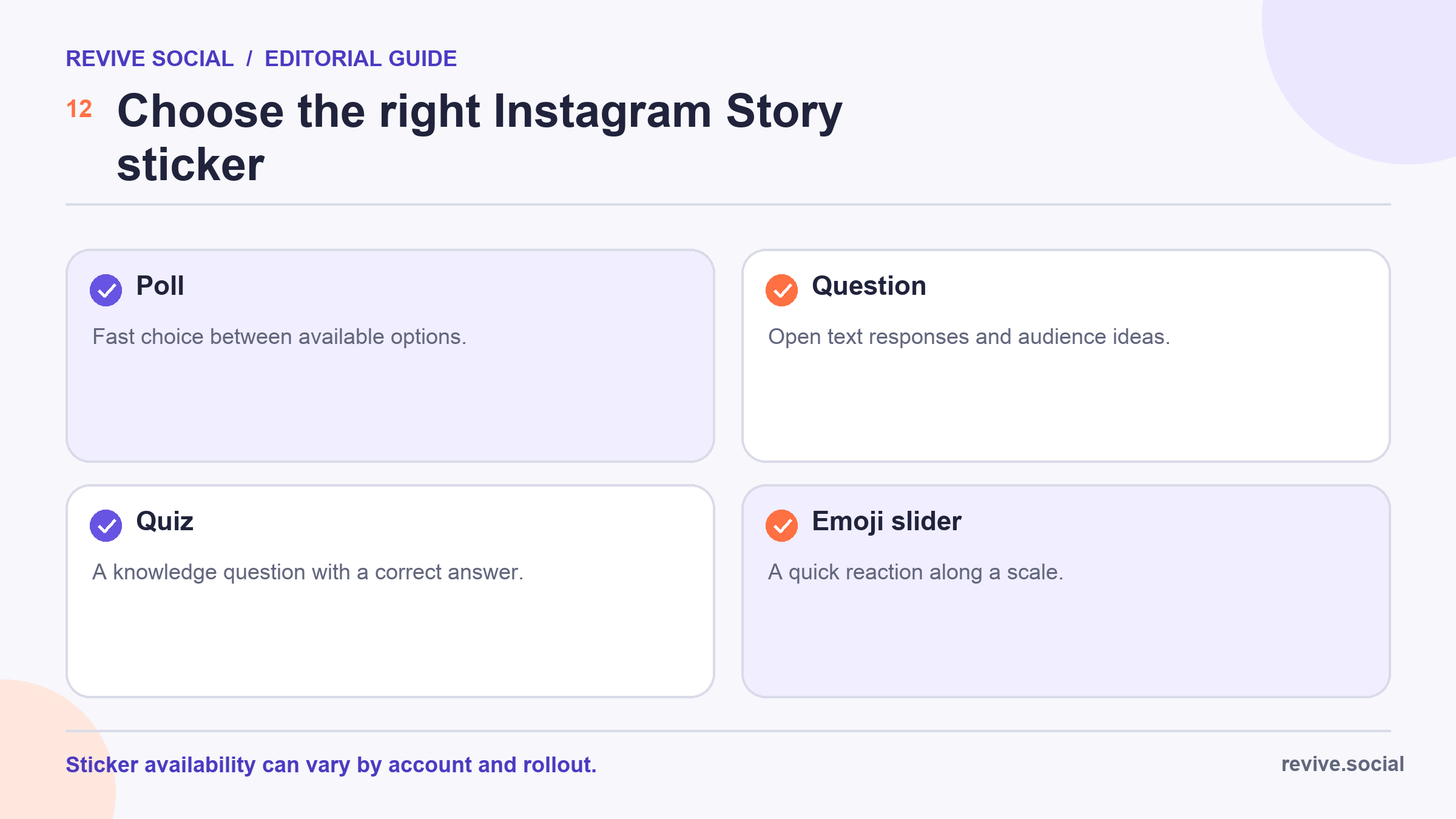
Choose the sticker by the answer you need. A Poll is built for a quick choice. A Question sticker collects open text. A Quiz tests a correct answer, while an Emoji Slider captures a reaction along a scale. Calling all four “polls” makes it harder to plan the prompt and interpret what comes back.
| Sticker | Answer shape | Best use | Main limitation |
|---|---|---|---|
| Poll | Choice between available options | Preference or direction | Little room for explanation |
| Question | Open text | Ideas, examples, or questions | More effort and moderation |
| Quiz | One marked correct answer | Knowledge checks | Wrong fit for opinions |
| Emoji Slider | Reaction on a scale | Lightweight sentiment | Scale meaning can be ambiguous |
The original Story Poll launched as a two-option choice, with the creator able to see how accounts voted.[1] Current controls may differ, so work from the interface available to your account instead of assuming every Poll still uses fixed Yes and No labels. 🧩
Create a poll in the Story composer
1. Open the Story composer
Start a new Story from the controls available in your app, then capture or select the background photo or video. Leave enough calm visual space for the question and answer controls. A busy image can make even a short Poll difficult to read.
2. Choose the Poll sticker
Open the sticker tray and select Poll if it is present. The platform continues to add and change Story sticker experiences, which is why the available set can evolve over time.[2] If Poll is absent, do not substitute Question or Quiz unless that answer format still fits your goal. 🔎
3. Write the question and options
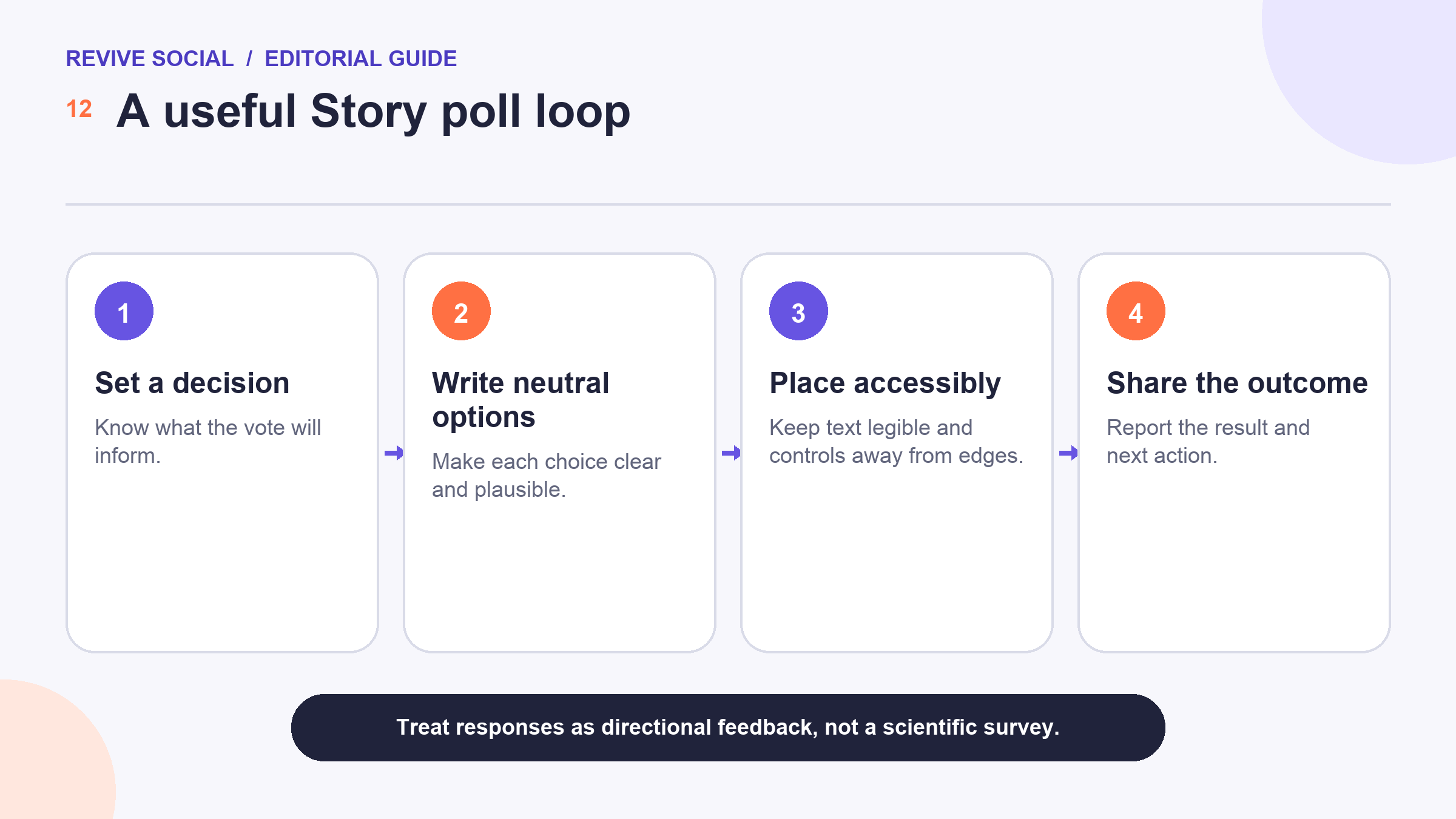
Ask about one decision. Keep the options distinct, plausible, and neutral. “Which tutorial should come next: reporting or scheduling?” is easier to use than “Do you want more great content?” If neither answer could change what you do, the Poll may not need to be published.
4. Place and preview the sticker
Keep the question and controls away from screen edges and from interface areas that may cover them. Check contrast, spelling, and the relationship between the background and each answer. Preview the whole Story sequence so the Poll makes sense even if someone missed an earlier frame. 👀
5. Publish to the intended audience
Review the selected audience and any sharing settings before publishing. If the topic is sensitive or meant for a limited group, a broad public Story may be the wrong surface. After publishing, open the Story from the account to confirm the text, controls, and audience behave as expected.
If the Poll needs context, use a short sequence instead of compressing every detail into one frame. The first Story can state the decision, the second can explain the two options, and the third can carry the Poll. Keep the sequence concise, because people may enter late or move forward quickly. 🎬
Repeat the essential noun in the Poll itself. “Which format should the next tutorial use?” remains understandable when someone missed the setup, while “Which one?” does not. If the options depend on images, label those images directly and make sure the relationship between each image and answer is unambiguous.
Set a response window that matches the decision. Do not ask followers to choose an event time after the booking deadline or vote on a product detail that has already been finalized. A Poll earns more trust when both options are real and the stated follow-up is still possible. ⏱️
Read results and follow up responsibly
Use the Story’s available insights or viewer controls to review responses while they are available to your account. Record the question, options, response window, and audience context. A result without that context is easy to overstate later. 📝
Treat the result as directional feedback, not a scientific survey. People self-select into seeing and answering the Story, and the group may not represent customers, followers, or the wider market. A close result may support another round of research rather than a final decision.
Do not publish a list of individual voters or imply that a person endorsed a broader statement they did not see. When sharing the outcome, use aggregate language and explain the limited context. If the Poll informed a choice, show the next step so participation has a visible purpose. ✅
Save a simple research record before the Story disappears from everyday view. Capture the exact question and options, account, audience setting, publication time, response period, vote totals, and the decision made. If the platform provides additional aggregate insights, note the report and filters instead of copying unnecessary account-level data.
Compare Polls only when the conditions are reasonably similar. A product-choice question posted during a launch cannot be directly compared with a casual preference question on a quiet weekend. Topic, creative, sequence position, audience activity, and paid distribution can all affect response volume. 📐
When the vote informs a material business decision, combine it with stronger evidence such as support themes, site behavior, interviews, or purchase data. The Poll can reveal a direction worth testing, but it should not carry more certainty than the collection method supports.
Choose a poll question that is easy to answer
A strong Poll connects to one small decision and needs little explanation. Use audience language, avoid double questions, and remove emotional pressure from the options. If the prompt asks “Which is cheaper and easier?”, respondents may agree with one part and not the other.
- Content choice: “Checklist or video walkthrough?”
- Timing preference: “Live workshop or recorded lesson?”
- Product education: “Which setup step needs more detail?”
- Community planning: “Beginner Q&A or advanced examples?”
- Event recap: “Full recap or key takeaways?”
Do not ask a Poll to collect private support details, health status, precise location, financial circumstances, or other sensitive information. Use an approved private channel when the answer must be linked to an individual case.
For a broader bank of open and closed prompts, see these Instagram questions to ask followers. Choose only questions that the team is prepared to moderate and use. 💬
Design for accessibility and safe placement
Use readable text, strong contrast, and a background that does not compete with the Poll. Keep important information away from edges, profile labels, and response controls. Do not use color alone to communicate which option is intended for which group.
- Write the essential question as text, not only as speech in a video.
- Use captions for spoken context when the current composer provides them.
- Avoid rapid flashing or distracting motion behind the options.
- Keep answer labels short enough to scan before the Story advances.
- Review the finished Story on a real phone before reusing the layout.
Make each Story understandable on its own when possible. People can enter a sequence late, tap forward quickly, or view without audio. A one-line setup such as “Help choose the next tutorial” gives the Poll a reason. 🎨
Scheduling, API, and account limitations
Support for publishing an Instagram Story through an API or third-party tool does not automatically include support for interactive stickers. Media publishing and in-app sticker creation are separate capabilities. The public Instagram API documentation is the current place to check publishing eligibility and boundaries.[3]
Before committing to a scheduled campaign, run an end-to-end test with the exact account type, tool, media format, and workflow. Confirm whether the sticker must be added manually in the Instagram app. Do not advertise an interactive Poll until the published Story has been checked. 🧪
Account type, region, age restrictions, app version, and staged rollouts can also affect availability. Write a fallback into the plan, such as a caption question, a link to a form, or a simple noninteractive Story followed by a manual Poll.
Troubleshoot missing stickers or controls
- Update Instagram through the official app store for the device.
- Close and reopen the app, then start a fresh Story.
- Check whether other interactive stickers appear.
- Review account eligibility, region, and current official announcements.
- Test another eligible account on the same device to isolate the scope.
- Use a suitable fallback instead of repeatedly deleting a live Story.
If the sticker appears but responses do not, confirm the Story audience, expiration window, and whether people can interact with the post. Low response volume can also reflect the question, timing, or audience fit, not a technical defect. 🚦
If controls are visible but the Story fails to publish, save the original media, check the connection, and try a simple test Story without the sticker. That separates a general upload problem from a sticker-specific issue. Avoid repeating the full campaign post until the test confirms which part is failing.
For a team workflow, write a fallback beside every scheduled Poll. Name the person who will add the interactive sticker manually, the latest acceptable publication time, and the noninteractive alternative. 🗒️ A campaign should not depend on one unlabeled control appearing at the last minute.
Record the app version, account type, device, and observed error when reporting a repeatable problem. Those details make support requests more useful than “the Poll is broken” and help the team distinguish an account rollout from a media or connection issue.
After the Story expires, preserve only the content that remains useful and appropriate. The guide to Instagram Highlights explains how to maintain longer-lived profile collections without treating every temporary Poll as evergreen.
Archive the decision note with the campaign brief, then remove any copied response data that has no continuing purpose under the team’s retention policy.
References
- [1] Instagram: Introducing polls in Instagram Stories
- [2] Meta: New stickers in Instagram Stories
- [3] Meta: Instagram API documentation

