
How to Use Instagram Highlights for Business
 Revive.Social Editorial
 Instagram Highlights let you keep selected Stories visible on your profile after the normal Story window ends. For a business, the most useful Highlights act like a small information system: they answer common questions, show current proof, and guide a visitor toward an appropriate next step.
This guide shows how to create and edit Highlights, choose categories, coordinate covers and names, handle changing features, and assign ongoing maintenance. It avoids fixed character or visibility limits because profile layout and tools can change. 📌
Understand what Instagram Highlights preserve
A Story is a temporary publishing format. A Highlight is a profile collection that can preserve selected Stories until you remove them. Meta introduced Stories Archive and Highlights as related but distinct features: the archive stores eligible past Stories privately, while a Highlight makes selected items visible from the profile to people allowed to see those Stories.[1]
- Story: the original piece of published content.
- Archive: a private source of past Stories when archiving is enabled and available.
- Highlight: a profile collection visible to the people allowed to see its selected Stories.
- Cover: the visual label that helps someone recognize the collection.
A Highlight does not turn an old offer into an evergreen one. It keeps the Story accessible, including any stale dates, prices, links, product claims, or event details inside it. That is why maintenance is part of the strategy, not an optional cleanup step. 🧹
Use Highlights for information that remains useful after the original Story moment. Time-sensitive announcements can still appear, but they need a clear owner and expiry review.
Create a Highlight from a Story or archive
The exact button names and placement may differ by app version, account, or rollout. Instagram maintains current Help Center guidance for Stories and Highlights, so verify the labels before following or publishing a click-by-click workflow.[3]
The durable workflow is:
- Publish an eligible Story, or open the account’s Story archive if archiving is enabled.
- Choose the available option to add the Story to a Highlight.
- Select an existing Highlight or create a new collection.
- Give the collection a short, distinct name.
- Choose or upload a cover that still makes sense at profile size.
- Preview the complete sequence from the profile as a member of the intended audience.
Start with a small set instead of creating a Highlight for every campaign. Each collection should answer a durable visitor question. If two collections overlap, combine them so the profile remains easy to scan. 🗂️
Check the first Story in each sequence. It should orient a new visitor without assuming they saw the original campaign. A short title card can explain what the collection contains, provided the text is readable and the information is current.
Edit, reorder, and remove Highlights
Open the Highlight’s available edit controls to change its name, cover, and included Stories. You may be able to add archived Stories or remove items without deleting the original archived copy. Always review the result from the profile after saving because the editor view does not show every audience context.
- Add: include a Story that strengthens the collection’s purpose.
- Remove: drop expired, duplicated, off-brand, or unclear content.
- Rename: make the category easier to distinguish without relying on exact truncation rules.
- Change cover: restore visual consistency or clarify the category.
- Retire: remove the entire Highlight when its purpose no longer exists.
Do not depend on a fixed number of visible Highlights or a permanent order. Profile layout can change, and adding or updating content may affect what visitors see first. Put the most important orientation into clear names and the content itself. 🔄
If sequence matters, open every Story in order and ask whether a visitor can understand the progression without prior context. Remove repeated introductions and place the most durable explanation before temporary examples.
Use a simple sequence pattern for instructional collections: orientation, problem, explanation, proof or demonstration, limitation, and next step. For an FAQ collection, let each Story answer one question completely instead of splitting a short answer across many slides. Add spoken or written context so the message does not depend on audio alone, and check that text is readable against the background. 🧩
Keep a source list outside Instagram for claims, dates, prices, and links used in each collection. When a fact changes, the team can identify every affected Story instead of opening the full profile and guessing.
Choose categories that answer customer questions
Organize Highlights around visitor needs rather than internal departments. A new customer rarely knows which team owns the answer. The following categories are starting points, not a required set:
- Start here: who the business serves, what it offers, and the clearest next step.
- Products or services: durable demonstrations, use cases, variations, or process explanations.
- FAQ: recurring questions about fit, access, timing, care, or ordering.
- Reviews or results: permissioned customer stories presented with honest context.
- Events: current dates, access information, recaps, and a removal plan after expiry.
- About: people, values, process, or location information that helps build appropriate trust.
- Contact: the supported path for booking, purchasing, directions, or help.
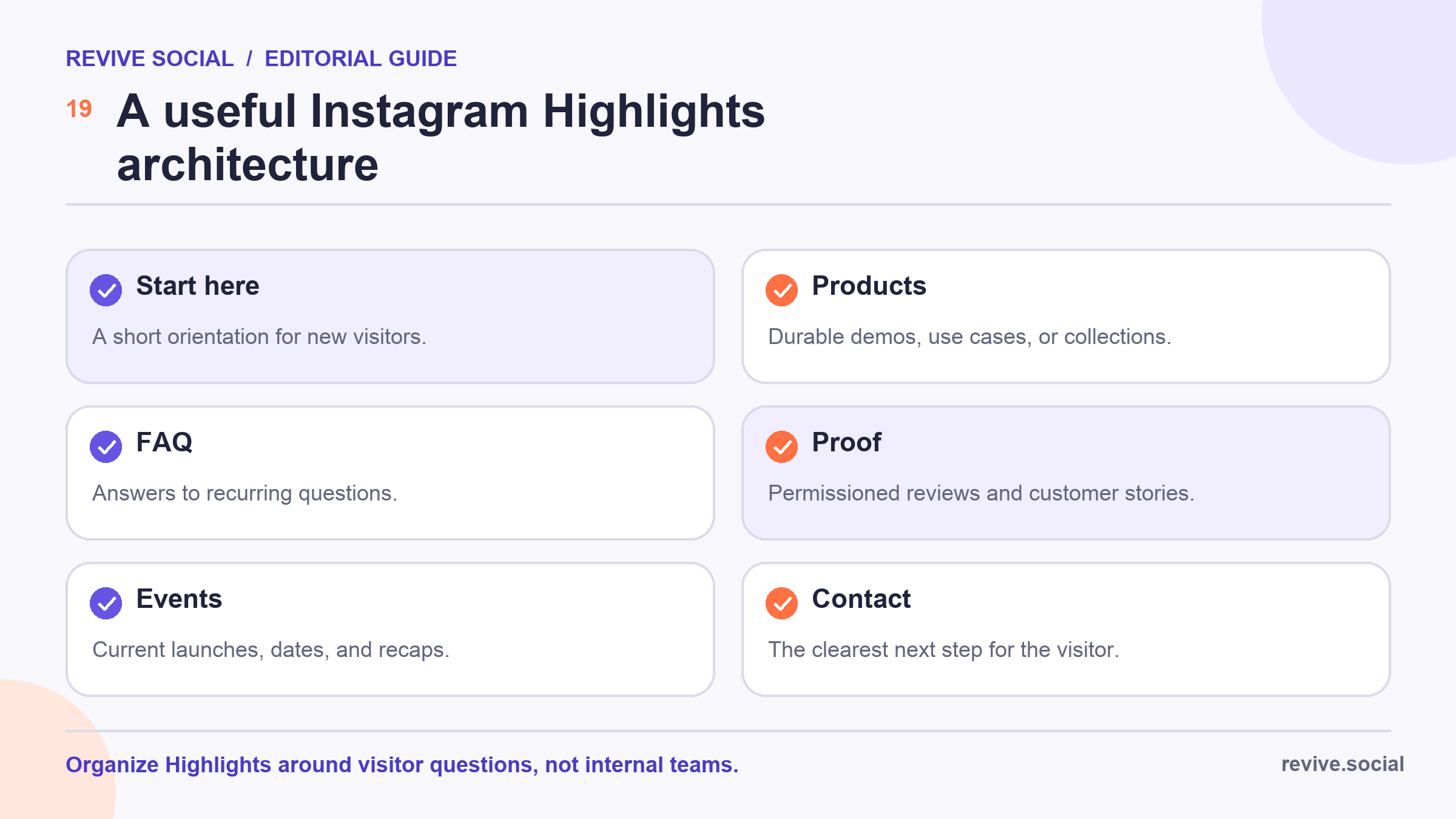
A local service business may need Areas, Process, Work, FAQ, and Book. A software company may need Start, Use cases, Tutorials, Updates, and Support. Use the vocabulary customers recognize, then test whether someone unfamiliar with the business can predict what each Highlight contains. 🧭
Do not show a review, customer photo, private message, or event attendee without the rights and permission needed for that use. A public Story is not automatically permission for a brand to preserve it in a business Highlight.
Before adding a category, complete a one-line design brief: visitor question, stories that answer it, final action, content owner, rights status, and review cadence. If the team cannot name the visitor question or owner, the collection is probably internal clutter rather than useful navigation. This gate also prevents the same Story from being copied into several overlapping Highlights. 📝
Use covers and names as readable profile navigation
A cover should help the visitor distinguish one category from another at a glance. Use a consistent visual system, strong contrast, centered subject matter, and simple shapes that survive a small circular crop. Do not put essential instructions inside the cover.
Names should be short enough to scan and distinct enough to stand alone. Avoid relying on a published character limit or an exact number of visible collections. Preview the current profile on the devices that matter to your audience instead. 🎨
- Use one icon style, stroke weight, and color logic across the set.
- Keep icons meaningfully different rather than changing only color.
- Pair icons with clear names so meaning does not depend on the image alone.
- Check contrast and readability at actual profile size.
- Confirm that every graphic is owned, licensed, or created for the account.
The dedicated guide to Instagram Highlight covers explains the design workflow in more depth. Keep this Highlight hub focused on organization and maintenance rather than duplicating that tutorial.
Handle links, commerce, and feature availability carefully
Story stickers and other content tools evolve. Meta’s later Story announcements demonstrate that the sticker surface continues to change, so an old screenshot should not be treated as a permanent feature map.[2] Account type, region, app version, eligibility, and rollout can also affect what appears.
If a Story includes a link or commerce action, verify it from the viewer-facing Highlight after saving. Test the destination, check campaign dates, confirm stock or availability, and provide an alternative path when the feature is unavailable. Do not describe the retired swipe-up behavior as the current universal workflow. 🔗
Use interactive Stories for timely research when the available sticker fits the question. The guide to Instagram Story polls covers that interaction separately. Before preserving a response or result in a Highlight, review privacy, consent, and whether the finding will remain accurate.
Commerce availability is not universal. Avoid promising product tags, tickets, booking, or another control unless it has been verified on the target account and in the target region immediately before publication.
Maintain and measure a Highlight system
Assign a named owner and review the system on a predictable cadence. High-change categories such as Events, Offers, and Availability may need weekly checks. Durable categories such as About or Process can use a monthly or quarterly review.
- Open every Highlight and watch the complete sequence.
- Remove expired offers, dates, links, availability claims, and old interface instructions.
- Check that permissions still cover customer stories, reviews, music, and images.
- Test names and covers for clarity, contrast, and consistency.
- Confirm that contact, booking, product, and support destinations still work.
- Review available Insights and meaningful profile actions rather than relying on one vanity metric.
- Record the owner and next review date.
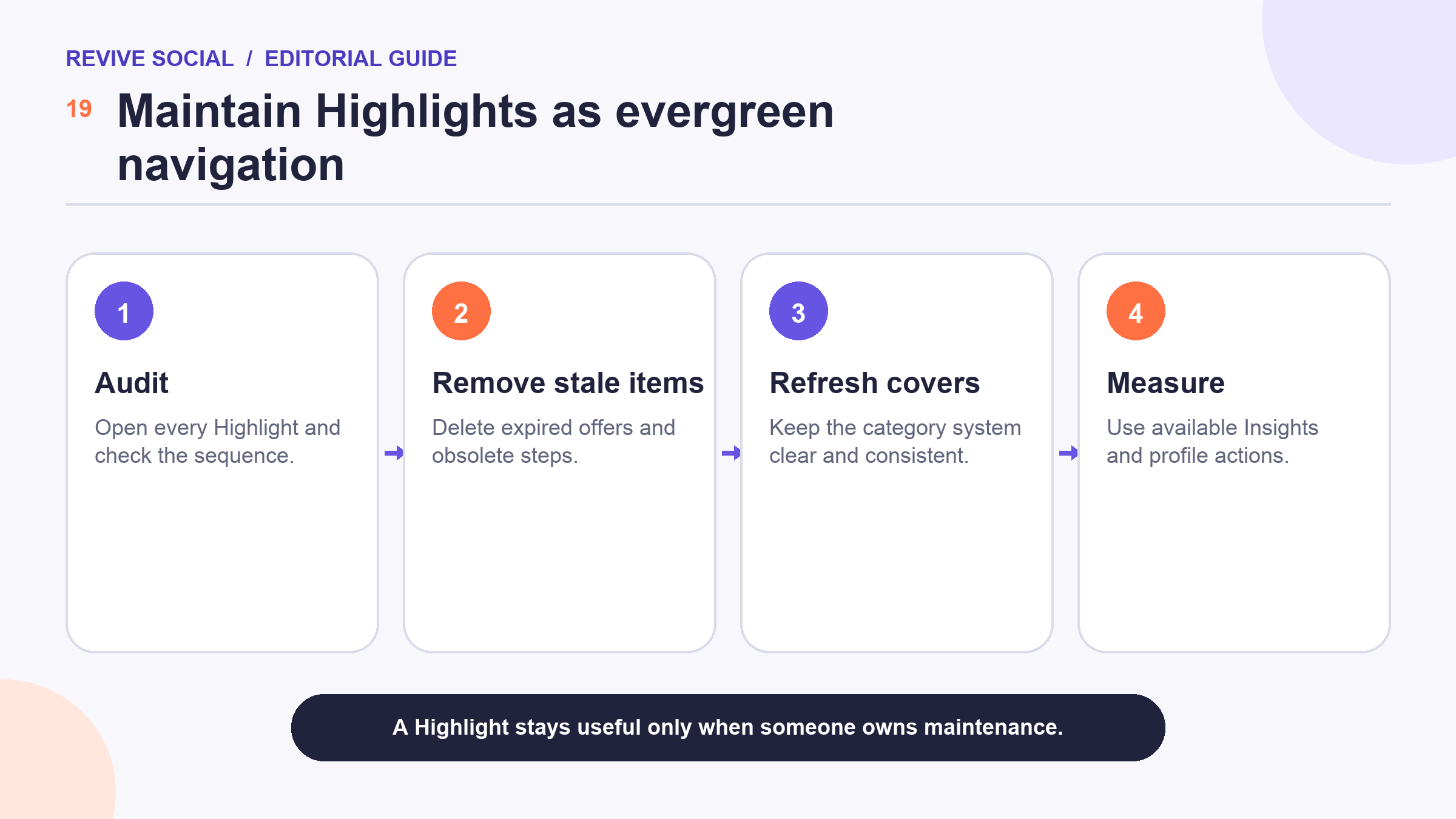
Use the measurement options currently available to the account and connect them to a question. Are visitors finding the right information? Are they taking the supported next action? Are outdated Stories creating confusion? The broader Instagram analytics guide can help frame a metric around a decision without assuming every account exposes the same data. 📊
| Question | Possible evidence | Decision |
|---|---|---|
| Do visitors understand the category? | User test and recurring questions | Rename or reorder |
| Does the sequence stay current? | Broken links and expired claims | Update or remove |
| Does it support a real action? | Available profile or website actions | Clarify the next step |
| Is it worth maintaining? | Usefulness compared with upkeep | Keep, combine, or retire |
Do not compare figures across periods unless the content, profile layout, campaign activity, and available metrics are comparable. Write down important changes and treat the analysis as directional when those conditions differ.
Begin with three to five categories that solve the most common visitor questions. Review them as a complete navigation system, remove anything stale, and expand only when a new category has a clear owner and purpose. ✅
Ask someone outside the content team to open the profile and find three things, such as the service area, an answer to a common question, and the contact path. Watch where they hesitate without coaching them. That small task test reveals unclear names, repetitive sequences, and missing context more reliably than an internal debate about which cover looks best.
Keep a lightweight inventory with each Highlight name, purpose, owner, source Stories, rights status, key links, and next review date. The inventory makes handoffs safer and exposes collections nobody is maintaining.
References
- [1] Meta: Instagram Stories Archive and Highlights announcement
- [2] Meta: New stickers in Instagram Stories
- [3] Instagram Help Center: Stories and Highlights guidance

