How to Use Pinterest Group Boards to Reach the Right Audience
 Revive.Social Editorial
 Pinterest group boards are shared boards where an owner allows other accounts to contribute Pins. They can support genuine collaboration around a topic, but joining one does not guarantee more reach, followers, or website traffic.
The useful question is not “How large is this board?” It is “Does this board serve the right audience, maintain clear rules, and produce results worth the work?” This guide gives you a current way to evaluate, join, contribute to, and measure a group board without relying on old growth promises. 📌
What Pinterest group boards are (and are not)
A personal board is managed by one account. A Pinterest group board has an owner and invited collaborators, with permissions controlled by the owner.[1] The owner can decide who contributes and can change access, so participation is a privilege rather than a permanent distribution channel.
A group board is also not an automatic “audience share.” Pinterest decides where Pins appear, board followers may not see every contribution, and a large follower count does not establish current activity. Judge the board by topical fit, moderation, Pin quality, and your own observed outcomes. 🔎
Older guides sometimes repeat a 200,000-Pin account limit. Current Pinterest Help says there is no limit to the number of Pins an account can create.[2] That does not mean unlimited posting is useful or safe. Quality and relevance still matter, and repetitive behavior can create spam risk.
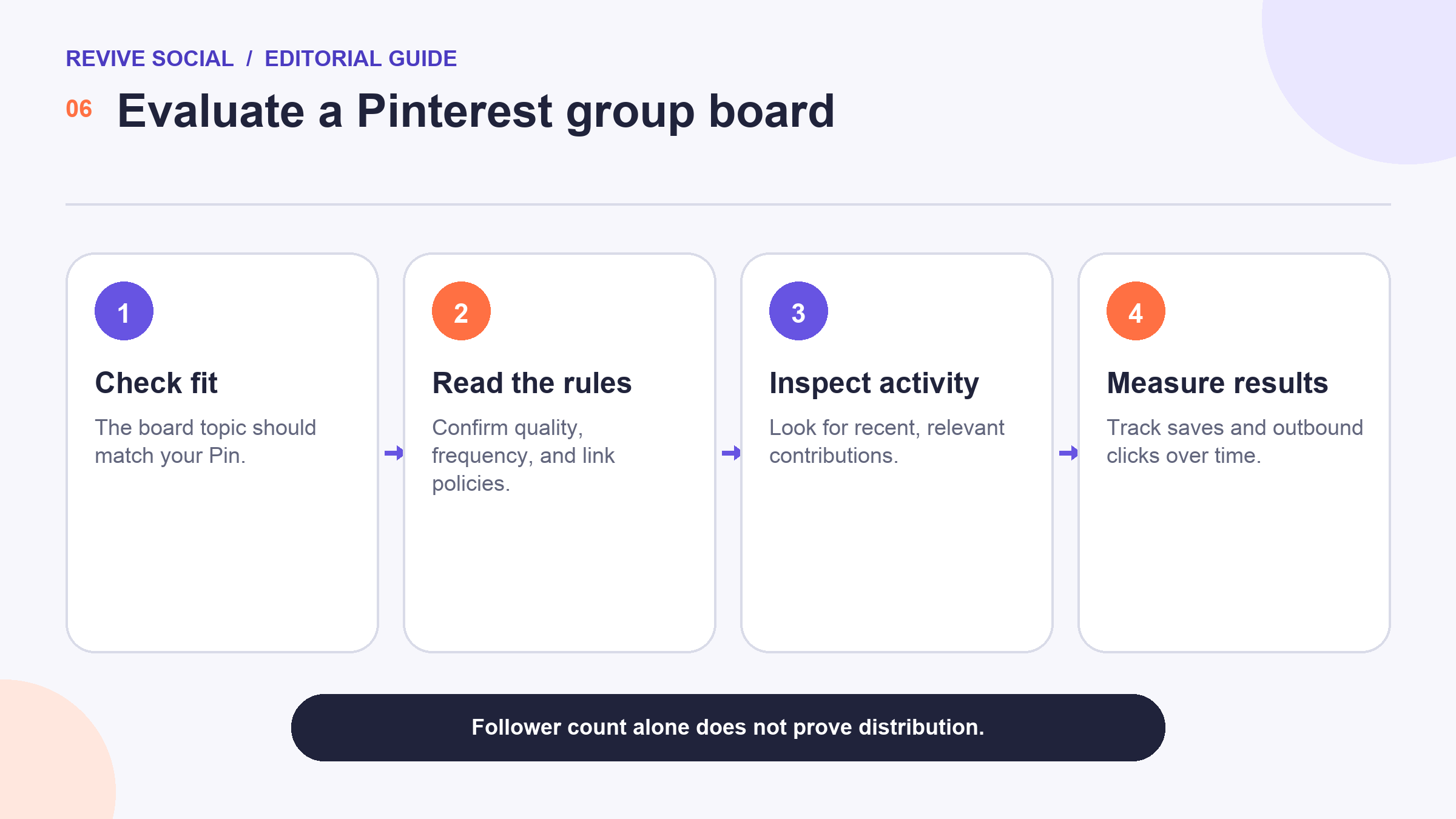
How to evaluate a group board before joining
Open the board and assess recent content before contacting the owner. A useful board should have a coherent subject, Pins that serve a recognizable audience, and evidence that someone maintains it. Do not rely on a directory’s description or an old screenshot.
- Audience fit: Would the people interested in this board genuinely value your Pin?
- Recent activity: Are useful, relevant Pins still being added?
- Topical coherence: Does the board stay focused instead of collecting unrelated links?
- Moderation: Are duplicates, broken links, and off-topic promotions controlled?
- Outbound-link policy: Do the rules allow your content type and destination?
- Content quality: Do the Pins lead to useful, accurate pages rather than thin promotions?
Inspect several weeks rather than the latest row of Pins. One active day may come from a single contributor, while a healthy board shows relevant participation over time. Note repeated domains, near-duplicate designs, and contributors who ignore the stated topic. 🧪
Read every visible rule. Some owners set a contribution frequency, require original Pins, restrict commercial links, or ask collaborators to save content elsewhere. If the expectations are vague or encourage mass repinning, the board may create more risk and maintenance than value.
How to find boards and check whether they accept contributors
Start inside your existing niche. Look at boards maintained by collaborators, professional communities, publications, and creators whose content standards you already understand. Search by the reader’s topic, then open promising boards and identify the owner and collaborator list.
A board being shared does not mean it accepts unsolicited requests. Check its description, linked website, and the owner’s current contact guidance. Pinterest’s live interface may offer an invite or request path depending on the owner’s settings, but exact labels can vary by device and rollout. 📬
Avoid static “best group board” lists unless they are recently verified and explain their method. Ownership, rules, activity, and availability can change. Likewise, do not depend on BoardBooster or another old tool merely because a legacy tutorial recommended it.
How to request access and contribute appropriately
Send a brief, specific request through the channel the owner names. Introduce your account, link one or two representative Pins, explain how your subject fits the board, and confirm that you read the rules. Do not send repeated messages or treat a lack of reply as consent.
Request template: “Hello, this board’s focus on [topic] fits the guides published at [site]. The contribution rules have been reviewed, and these two Pins show the relevant quality and subject. Would the owner consider adding this account as a collaborator? A no or no response will be respected.”
Customize the request instead of sending it to many owners. Mention one specific reason the content serves that board and exclude follower totals or promises about how often you will repin other people’s work. Collaboration should start with fit, not a transaction. 🤝
If you are invited, start slowly. Add one highly relevant Pin, confirm that it renders correctly and leads to the promised page, then observe how the board is maintained. A low-volume start makes it easier to correct mistakes before they become a pattern. 🌱
Pinterest’s Community Guidelines prohibit spam and deceptive or repetitive behavior.[3] Do not publish near-identical Pins in rapid succession, use misleading descriptions, rotate the same destination through unrelated boards, or automate a volume the owner did not approve.
- Follow the board’s topic and frequency rules.
- Use an accurate title, image, description, and destination.
- Disclose commercial relationships where required.
- Remove or correct a Pin when the page becomes inaccurate or unavailable.
- Respect the owner’s decision to change permissions or remove a contribution.
How to make Pins useful to the board’s audience
Design for the reader’s question. The image should communicate the topic at a glance, the description should set an accurate expectation, and the destination should deliver the promised answer. The guide to optimizing Pinterest images can help with creative fundamentals.
Create an original Pin for a genuinely useful page rather than recycling the same graphic across every board. Vary the creative only when each version tests a meaningful idea, such as a different reader benefit or visual explanation. Decorative variation is not a substitute for relevance. 🎨
Use a lightweight editorial check before every contribution. Confirm the destination still works, the claim is current, the image has readable text and useful alt text, and the board remains appropriate. If a seasonal offer or dated event has ended, update or remove the Pin rather than leaving misleading material in a shared space.
Keep a contribution log with the board, Pin URL, destination, date, creative version, and intended audience. The record helps you avoid accidental duplicates and gives the owner a clear answer if a link or claim needs correction.
Check the destination on mobile, confirm that the image and headline match, and add tracking parameters only when your analytics and privacy practices support them. A save can indicate future interest, while an outbound click shows that someone left Pinterest for the linked page. Neither guarantees a conversion.
How to measure whether a board is worth your time
Use Pinterest Analytics for available Pin and board metrics, then compare them with referral and conversion data on your own site.[4] A business account may be required for the relevant analytics features.
Set an observation window before you begin, such as four to eight weeks, depending on your publishing cadence. Record the Pins contributed, impressions or saves where available, outbound clicks, engaged sessions, conversions, and time spent. Compare like with like rather than one new group-board Pin with an established top performer. 📈
Create a baseline from comparable Pins published to your own boards during the same period. Match the topic, destination, and creative quality as closely as practical. Seasonality, audience overlap, and uneven distribution will remain, but the baseline is more useful than judging the group board from a single click total.
Review quality as well as volume. One visit that completes the intended action can matter more than many accidental clicks, while saves may signal future interest that has not reached the website yet. Define the primary outcome before looking at the result so the winning metric is not chosen afterward.
Do not claim that the group board caused every visit. Other distribution, search, seasonality, and the content itself can influence results. The goal is a practical keep, adjust, or stop decision, not proof of a universal group-board effect.
When to leave a board and what to try next
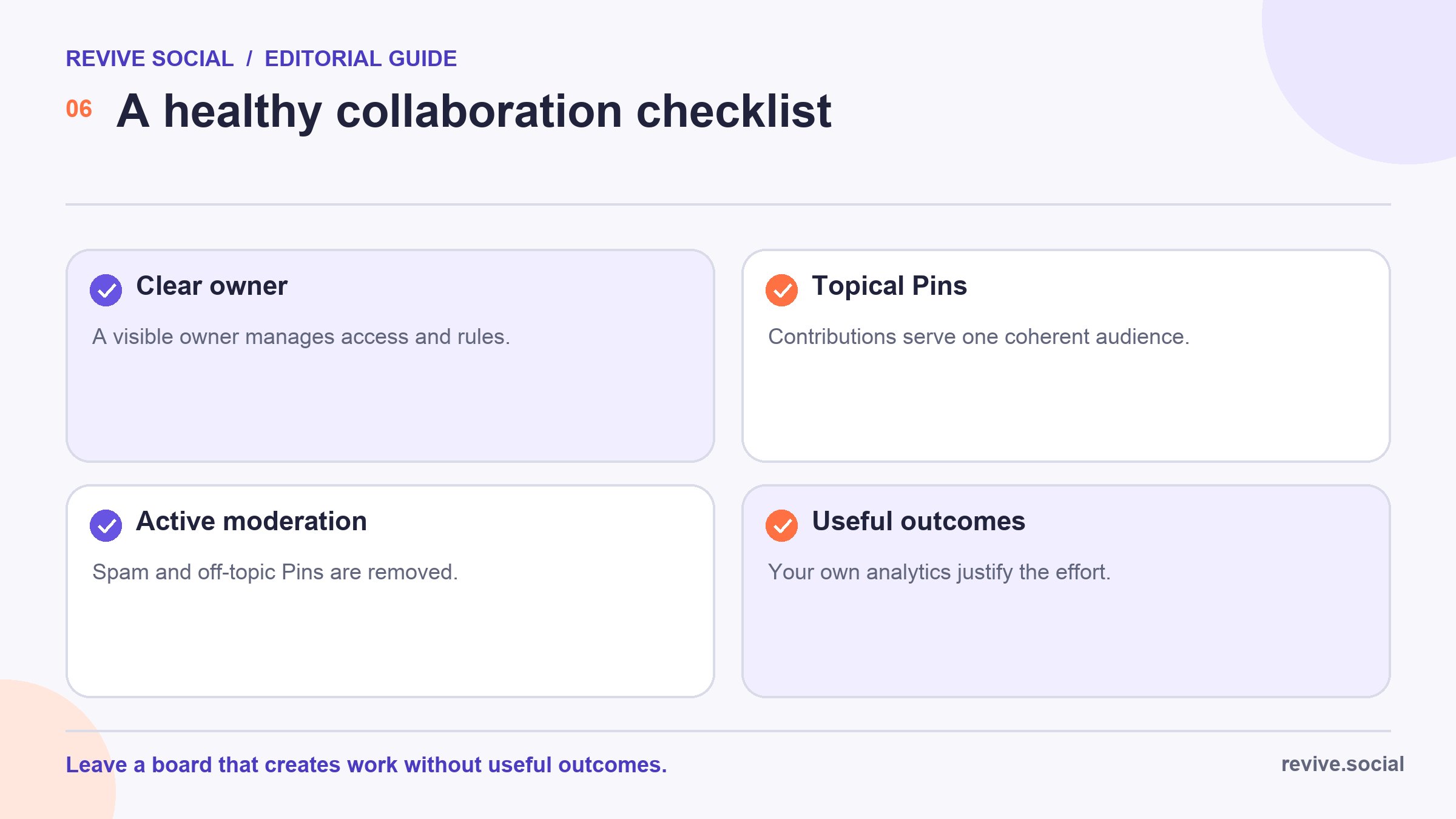
Leave or pause when the board drifts off-topic, fills with spam, changes rules in a way you cannot meet, sends no useful traffic during the agreed test, or consumes more time than the outcome justifies. Save your measurement notes and remove outdated contributions when appropriate.
Shift the effort toward your own well-structured boards, stronger creative, search-informed descriptions, or a broader Pinterest marketing strategy. If you need business-account context, the Pinterest for business guide is the more relevant next step. 🔁
Pinterest group boards can be useful collaborations, but they are not shortcuts. Vet the board, ask permission, contribute relevant Pins at a restrained pace, and let your own data decide whether the relationship deserves continued work.
Recheck the board rules and Pinterest Help before each new campaign. A permission granted for one content program does not automatically cover a different topic, destination, or posting cadence, so record the owner’s response before you contribute.
References
- [1] Pinterest Help: Group boards
- [2] Pinterest Help: Limits for Pins, boards, and follows
- [3] Pinterest Community Guidelines
- [4] Pinterest Help: Pinterest Analytics

